Hiring a cleaning company for an office is not just about finding someone who can vacuum floors and empty trash. The company will be working around employees, desks, equipment, restrooms, kitchens, confidential areas, and sometimes the building after normal business hours.
For businesses comparing office cleaning in San Francisco, the right provider should match the way the workplace actually operates. That means looking at service scope, cleaning frequency, staff consistency, insurance, California janitorial requirements, quality control, and how the company handles problems after service begins.
A low quote can look attractive at first, but if important tasks are excluded or the cleaning team changes constantly, the contract may create more work for the office manager instead of less.
Start With the Cleaning Needs of Your Own Office
Before comparing companies, define what your workplace actually needs.
A 3,000-square-foot private office with 15 employees should not automatically receive the same cleaning plan as a busy coworking space with several conference rooms, kitchens, and daily visitors.
Walk Through the Office by Area
Review:
- Reception and lobby
- Workstations
- Conference rooms
- Private offices
- Restrooms
- Break rooms
- Kitchens
- Hallways
- Elevators or shared building areas
- Carpeted zones
- Hard floors
- Interior glass
- Waste and recycling points
Then note which areas become dirty fastest.
This gives you a better basis for comparing an office cleaning company because each provider can quote the same scope rather than guessing what you expect.
Read More: Top Rated Bay Area Cleaning Company for Office Cleaning
Decide How Often the Office Actually Needs Cleaning
Frequency is one of the biggest factors in both cost and results.
Some San Francisco offices need cleaning every evening. Others may need three visits per week, while smaller workplaces can operate with a mixed schedule where restrooms and kitchens receive more attention than private offices.
The CDC recommends basing cleaning frequency partly on how often surfaces are touched and how much traffic an area receives. High-touch surfaces should receive regular cleaning, while high-traffic spaces may need attention more frequently.
Daily Service Often Makes Sense When:
- Many employees work on-site each day.
- Customers or clients visit regularly.
- Restrooms receive heavy use.
- The office has a shared kitchen.
- Trash accumulates quickly.
- Several people use the same meeting rooms.
- Floors receive substantial entrance traffic.
Less Frequent Service May Work When:
- The office has a small staff.
- Attendance is limited on certain days.
- Visitor traffic is low.
- Employees work in private offices.
- Food areas receive little use.
The better approach is to assign cleaning frequency by zone rather than applying one schedule to every room.
Ask for a Written Scope of Work
“Office cleaning” can mean different things to different providers.
One company may include restroom supplies, interior glass, kitchen appliances, and spot cleaning in its standard service. Another may charge separately for several of those tasks.
A written scope removes that uncertainty.
The Cleaning Proposal Should State:
- Which rooms are included
- Which tasks happen during every visit
- Which tasks happen weekly or monthly
- Floor-care methods
- Trash and recycling responsibilities
- Restroom cleaning
- Kitchen cleaning
- High-touch surface cleaning
- Interior glass
- Supply restocking
- Periodic deep-cleaning tasks
- Any exclusions
This makes it much easier to compare two quotes fairly.
A cheaper proposal is not actually cheaper if it leaves out work that the business expects to receive.
Verify California Janitorial Registration
This is an important California-specific step.
The California Property Service Workers Protection Act requires janitorial employers that meet the statutory definition to register annually with the Labor Commissioner’s Office. The law applies broadly to businesses providing janitorial services through employees, contractors, subcontractors, or franchise arrangements.
Before hiring a provider, confirm that the company has the appropriate current janitorial registration where required.
Why This Check Matters
California’s registration system is connected with employer responsibilities such as:
- Worker records
- Required training
- Wage and hour compliance
- Workers’ compensation documentation
- Janitorial employer accountability
The state provides a registration-search tool through the Department of Industrial Relations.
This gives businesses a straightforward way to verify a provider rather than relying only on a statement in a proposal.
Check Worker’s Compensation and Liability Insurance
Cleaning crews work around flooring, furniture, electronics, glass, plumbing fixtures, and building occupants.
Accidents can happen.
A cleaner may slip while carrying supplies, damage office equipment, or accidentally cause property damage during service.
California’s janitorial registration process requires employers with workers to provide workers’ compensation documentation or an applicable exemption.
Your own contract review should also consider general liability coverage.
Ask for Current Documentation
Do not rely on a statement that the company is “fully insured.”
Request the relevant certificate and verify that it is current.
If your landlord or property manager has specific insurance requirements for vendors entering the building, confirm those limits before signing the contract.
Find Out Who Will Actually Clean the Office
The salesperson who walks through the office may not be the person responsible for daily service.
Ask how staffing works after the contract begins.
Useful Questions Include:
- Will the same crew return regularly?
- Who supervises the cleaners?
- How are replacement staff handled?
- How are new cleaners trained for this location?
- Is there a site lead?
- How does the company handle staff absences?
- Are subcontractors used?
Consistency matters because cleaners become familiar with the layout, access instructions, sensitive areas, and expectations of the workplace.
Constant crew changes can lead to missed tasks and repeated instructions.
Ask How Cleaning Staff Are Trained
Cleaning chemicals, disinfectants, equipment, floor machines, and lifting tasks all require safe procedures.
The CDC recommends that cleaning staff be trained on the proper use of cleaning and disinfecting products and appropriate personal protective equipment where needed.
California also requires registered janitorial employers to provide specified sexual violence and harassment prevention training to covered workers.
Training Should Match the Work
For example:
General office cleaners should understand surface care, chemical use, waste handling, and office equipment precautions.
Floor-care technicians should know how to operate machines and select methods appropriate to the flooring.
Cleaners working around electronics should understand that monitors, keyboards, and other devices cannot always be treated like ordinary hard surfaces.
Training helps reduce both cleaning mistakes and workplace safety problems.
Check How the Company Handles Building Access
Many San Francisco offices are cleaned before employees arrive or after they leave.
That means the cleaning company may receive keys, alarm codes, badges, elevator access, or entry instructions.
The access policy should be clear before service starts.
Ask About:
- Key control
- Badge assignment
- Alarm procedures
- Lost-key reporting
- After-hours entry
- Building security requirements
- Access removal when a cleaner leaves the company
A cleaning crew should receive only the access required to perform its work.
If building management has specific vendor-entry procedures, include those requirements in the cleaning plan from the beginning.
Look at Quality Control, Not Just the Initial Cleaning
Many cleaning contracts start well.
The harder question is what happens three months later.
A dependable office cleaning company should have a way to catch declining service before the client has to send repeated complaints.
Quality Control Can Include:
- Supervisor inspections
- Cleaning checklists
- Completion logs
- Periodic client reviews
- Site inspections
- Written problem tracking
You should also know who to contact if something is missed.
If every complaint goes through a general voicemail or several layers of staff, even a simple issue can take days to correct.
Ask What Happens When Something Is Missed
No cleaning company will perform every task perfectly forever.
What matters is the response.
Suppose the kitchen floor is missed, a restroom runs out of supplies, or trash is left in one conference room.
Ask:
- Who receives the complaint?
- How quickly is it acknowledged?
- Will someone return to correct the issue?
- Is the problem documented?
- What happens if the same task is missed repeatedly?
A clear correction process is often more valuable than a promise that problems will never happen.
Compare Cleaning Products and Methods
Not every surface can be cleaned with the same chemical.
Stone, wood, carpet, glass, stainless steel, painted walls, upholstery, and electronics may require different methods.
Ask the company how it decides which products and equipment to use.
Pay Particular Attention to:
- Hardwood or specialty flooring
- Natural stone
- Carpet
- Computer equipment
- Glass partitions
- Upholstery
- Stainless steel
- High-touch surfaces
The cleaning plan should follow the material rather than using one chemical across the entire office.
If your company has environmental or fragrance requirements, discuss those before signing the contract as well.
Cleaning and Disinfecting Should Not Be Treated as the Same Task
Some proposals use “clean and disinfect” as a broad marketing phrase.
The two processes are different.
Cleaning removes dirt and reduces germs from a surface. Disinfection uses an appropriate chemical product to kill remaining germs after cleaning when the situation requires it. CDC guidance says routine cleaning is sufficient in many situations, with disinfection added when circumstances call for it.
Ask the Provider to Explain:
- Which surfaces are routinely cleaned
- Which are disinfected
- What products are used
- Whether label contact times are followed
- How electronics are handled
- When additional disinfection is recommended
This helps prevent unnecessary chemical use and clarifies what the service actually includes.
Floor and Carpet Care Should Be Planned Separately
Daily floor maintenance and periodic floor restoration are different services.
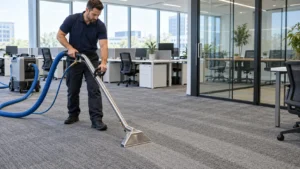
Vacuuming carpet each evening does not replace extraction or another appropriate deep-cleaning method. Similarly, routine mopping does not address every issue on commercial hard flooring.
Ask for a Floor-Care Schedule
It may include:
Routine service
- Vacuuming
- Sweeping
- Damp mopping
- Spot treatment
Periodic service
- Carpet extraction
- Machine scrubbing
- Floor polishing
- Grout cleaning
- Other surface-specific treatments
The cleaning company should explain which of these are included in the recurring contract and which are separately scheduled.
This prevents surprise charges later.
Review San Francisco Building Conditions Before Setting the Schedule
Local office conditions can affect cleaning frequency.
Street-level entrances may collect more outdoor soil. Wet weather can increase tracked-in moisture. Downtown offices with elevator traffic can move dirt from building common areas into suites throughout the day.
Older buildings may also have different flooring, ventilation, or access conditions from newer office properties.
Build the Plan Around Your Space
Look at:
- Entrance traffic
- Elevator access
- Number of floors
- Carpet vs hard flooring
- Building operating hours
- Loading and delivery activity
- Shared restrooms
- Shared kitchens
- Building management rules
A location walkthrough should influence the proposal more than a generic square-footage formula.
Understand How Pricing Is Calculated
Cleaning prices may be based on square footage, labor time, visit frequency, scope, building access, or a combination of these factors.
Do not compare totals until you understand what each price includes.
Ask Whether the Quote Covers:
- Cleaning labor
- Supervision
- Equipment
- Cleaning chemicals
- Trash liners
- Paper products
- Restroom consumables
- Periodic floor work
- Interior glass
- Deep cleaning
- Emergency or extra visits
Two proposals can be hundreds of dollars apart because one includes consumables and periodic services while the other does not.
The total monthly price makes sense only when the scopes match.
Be Careful With an Office Cleaning Quote That Is Far Below the Others
The lowest quote can sometimes be legitimate.
It can also mean the provider has estimated too few labor hours, excluded tasks, or plans to use a service model that does not match the property.
If one quote is significantly lower, ask why.
Check for Differences in:
- Number of weekly visits
- Estimated labor hours
- Cleaning scope
- Supervision
- Insurance
- Consumables
- Floor care
- Staffing model
A cleaning contract that is underpriced may start with acceptable results and then become difficult to maintain once the actual labor requirement becomes clear.
Check Contract Terms Before Signing
Price and scope are only part of the agreement.
Review how the business relationship can change later.
Look for:
- Contract length
- Cancellation notice
- Renewal terms
- Price-adjustment language
- Scope-change procedures
- Extra-service rates
- Holiday scheduling
- Complaint procedures
- Damage reporting
- Insurance requirements
A flexible contract can be useful when employee attendance or office use changes during the year.
If your company is growing, downsizing, or using a hybrid schedule, ask how cleaning frequency can be adjusted without rebuilding the agreement from scratch.
Use a Walkthrough to Compare Office Cleaning Companies
You can learn a lot about a provider by how the walkthrough is handled.
A useful walkthrough should involve questions about the property rather than only measuring square footage.
A Provider Should Be Looking At:
- Traffic patterns
- Flooring
- Restroom count
- Kitchen use
- Trash volume
- Sensitive surfaces
- Access restrictions
- High-touch areas
- Storage for cleaning supplies
- Areas requiring periodic service
The resulting proposal should reflect those observations.
If the quote looks identical to one that could have been sent to any office, important details may have been missed.
Also Read: What Are OSHA Cleaning Standards for Office Buildings?
Office Cleaning Company Comparison Checklist
Before making the final decision, compare each provider using the same criteria.
Compliance and Protection
- California janitorial registration verified where required
- Workers’ compensation documentation reviewed
- Liability insurance reviewed
- Building vendor requirements satisfied
Service
- Written scope provided
- Frequency matches office use
- Restroom and kitchen tasks are clear
- Floor and carpet care are defined
- Periodic services are identified
Staffing
- Crew structure explained
- Supervisor identified
- Replacement staffing process explained
- Cleaning staff training discussed
Communication
- Main contact identified
- Complaint process explained
- Quality inspections included
- Service changes can be requested clearly
Pricing
- Monthly price explained
- Supplies and consumables clarified
- Extra-service costs identified
- Contract and cancellation terms reviewed
If a provider cannot answer these questions clearly before the contract starts, communication is unlikely to become easier afterward.
Choose an Office Cleaning Company That Fits the Way Your Workplace Operates
The best provider is not necessarily the company with the longest task list or the lowest monthly quote. A stronger choice is one that understands your traffic patterns, cleaning priorities, building access, flooring, staffing needs, and service schedule, then puts those expectations into a clear scope.
For businesses comparing office cleaning in San Francisco, verify California janitorial requirements, insurance, staffing practices, quality control, and contract terms before making the decision. JJ & CC Cleaning can be considered when looking for an office cleaning company for a San Francisco workplace.